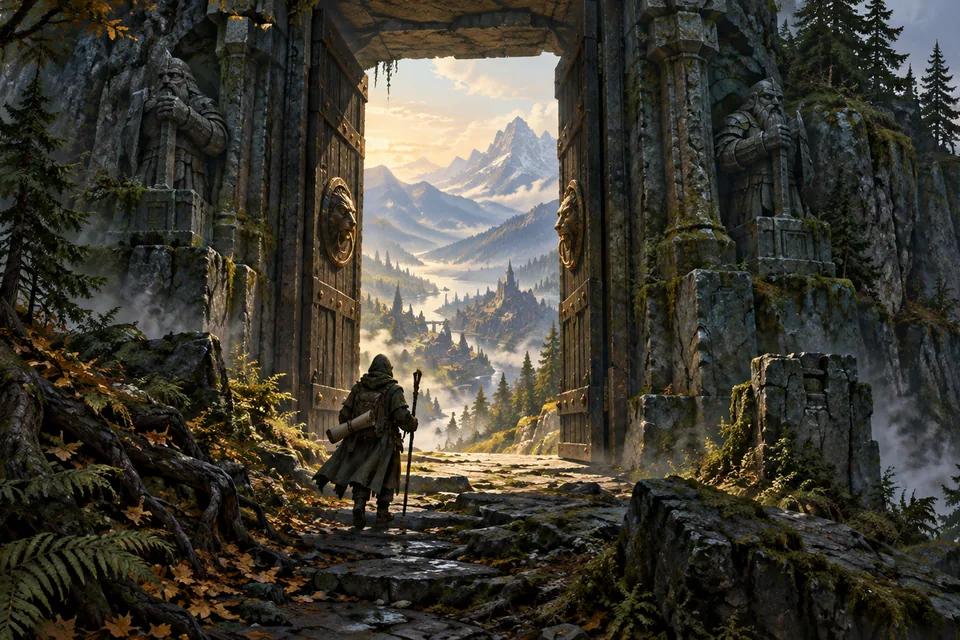
There is something irresistible about the possibility that another world exists just beyond our own. But why are we so fascinated by places we cannot see?
Stories about hidden worlds have captivated readers for generations. From magical kingdoms concealed behind ordinary doorways to mysterious civilisations beneath the Earth’s surface, the idea that reality might contain something extraordinary continues to inspire fantasy and science fiction.
Perhaps it is the thought that our familiar world is not quite as ordinary as it seems. Maybe it is the promise of adventure, the excitement of discovery or simply the opportunity to escape the limitations of everyday life.
Whatever the reason, hidden worlds occupy a special place in our imagination.
But what makes these fictional realms so compelling, and why do we keep returning to them?
The Irresistible Appeal of the Unknown
Human beings are naturally curious. Throughout history, we have explored unfamiliar lands, studied distant stars and searched for answers to mysteries that once seemed impossible to solve.
Stories about hidden worlds tap directly into this curiosity.
They invite us to imagine that the world we know is merely the surface of something much larger. Behind an unremarkable door, beneath an ancient ruin or beyond a seemingly impassable mountain, an entirely different reality might be waiting.
The possibilities are endless.
A forgotten civilisation might possess technology far beyond our understanding. An isolated kingdom could be governed by laws of magic. An ordinary forest might conceal creatures that have existed alongside humanity for thousands of years.
The attraction lies partly in the uncertainty. We want to know what is hidden, how it works and what might happen if someone discovers it.
And once the door opens, we want to step through.
Hidden Worlds Offer the Ultimate Escape
One of the greatest pleasures of reading fantasy is the opportunity to leave everyday life behind.
Our own world is governed by familiar routines, responsibilities and limitations. We understand its basic rules, even if we do not always like them.
A hidden world offers something different.
It might contain impossible landscapes, extraordinary creatures, ancient powers or entirely unfamiliar societies. Even the simplest journey can become an adventure when the traveller has no idea what lies ahead.
Yet successful fantasy does more than transport readers somewhere unusual.
It creates a world that feels real enough to inhabit.
The mountains must have a history. The cities need cultures and traditions. The inhabitants should have ambitions, fears and conflicts of their own.
Without these details, even the most spectacular imaginary kingdom can feel strangely empty.
This is why worldbuilding is so important in fantasy fiction. The more convincing the hidden world becomes, the easier it is for readers to lose themselves within it.
The Magic of Discovering Another Reality
Some of the most memorable stories about hidden worlds begin in entirely ordinary circumstances.
A child discovers a mysterious passage. An explorer finds an entrance beneath the ice.
The protagonist begins in a recognisable environment, just as the reader does.
Then something extraordinary happens.
This transition from the familiar to the impossible creates a powerful sense of wonder.
In The Lion, the Witch and the Wardrobe by C. S. Lewis, an ordinary wardrobe becomes the entrance to Narnia.
This type of story works partly because the extraordinary is concealed within the ordinary.
Readers can imagine themselves making the same discovery.
After all, who has never wondered whether an unfamiliar doorway, abandoned building or unexplored woodland might conceal something remarkable?
The most effective hidden-world stories encourage us to look at our surroundings differently.
Hidden Worlds Reflect Our Own Society
Although imaginary realms may contain magic, mythical creatures or advanced technology, they frequently explore very human concerns.
Power, loyalty, ambition, injustice, friendship and survival remain just as important in fictional worlds as they are in our own.
A hidden kingdom might struggle with political corruption. A secret civilisation could be divided by class or competing beliefs. An isolated society may face the consequences of exploiting its natural resources.
These conflicts give fantasy stories emotional depth.
They also allow writers to explore familiar issues from unfamiliar perspectives.
By removing readers from the assumptions of everyday life, speculative fiction can encourage them to question ideas they might otherwise take for granted.
A society governed by magic, for example, might reveal something about the relationship between power and responsibility.
A civilisation dependent on an unusual energy source could explore the dangers of technological progress.
The setting may be imaginary, but the questions are often very real.
Why Secrets Make Fantasy Worlds More Fascinating
A hidden world becomes particularly intriguing when its inhabitants have secrets of their own.
Perhaps the ruling dynasty has concealed the truth about its origins. Maybe the magical powers sustaining the kingdom are slowly disappearing. An ancient civilisation might have left behind warnings that nobody understands.
Such mysteries create tension and encourage readers to keep turning the pages.
However, revealing everything too quickly can weaken the attraction.
The most convincing fantasy worlds often retain an element of uncertainty.
Readers may learn how a particular form of magic operates without discovering where it originated. They might understand the history of a kingdom while remaining unaware of what lies beyond its borders.
This balance between explanation and mystery is an important part of effective storytelling.
A world should feel coherent, but it need not surrender every secret.
Indeed, the suggestion that unexplored places and unanswered questions remain can make an imaginary setting feel much larger than the story itself.
The Psychology Behind Our Fascination
Why do stories about hidden worlds appeal so strongly to our imagination?
One possible explanation is that they combine several powerful human experiences: curiosity, anticipation, wonder and the desire for discovery.
They also offer a particularly satisfying form of escapism.
Rather than simply presenting a different location, hidden-world fiction challenges our understanding of what is possible.
It asks a deceptively simple question:
What if everything we believe about reality is incomplete?
That question can be exciting because it introduces possibility into an otherwise familiar world.
Hidden worlds also appeal to our sense of personal transformation.
Characters who enter these realms rarely emerge unchanged. They discover abilities, confront fears, question their assumptions and learn things about themselves that ordinary circumstances might never have revealed.
In this respect, the journey into a hidden world often becomes a journey of self-discovery.
The external adventure mirrors an internal transformation.
And perhaps that is one reason these stories remain so memorable.
Hidden Worlds in Science Fiction
Although hidden worlds are often associated with fantasy, they are equally important in science fiction.
The difference usually lies in how the extraordinary is explained.
A fantasy writer might conceal a kingdom through enchantment. A science fiction writer could achieve a similar effect through advanced technology, unusual physics or an undiscovered natural phenomenon.
Imagine an immense civilisation beneath the oceans of an alien planet.
Or a technologically advanced society living inside an artificial structure that its inhabitants believe to be a natural world.
Perhaps an entire population exists within a simulated reality, unaware that anything lies beyond it.
Each premise offers opportunities to explore scientific ideas alongside the emotional appeal of mystery and discovery.
Science fiction can also challenge the distinction between what is hidden and what is simply beyond our present understanding.
After all, many things that once seemed impossible have become part of accepted scientific knowledge.
For speculative fiction writers, that boundary between imagination and possibility is particularly fertile territory.
Creating a Hidden World That Readers Believe In
For writers, inventing a hidden world presents both an opportunity and a challenge.
The opportunity is creative freedom. Almost anything can exist, provided the author establishes convincing rules.
The challenge is consistency.
If magic exists, readers need some understanding of its possibilities and limitations. If a civilisation has remained hidden for centuries, there should be a plausible explanation for its isolation.
Geography, history, economics and culture all contribute to the credibility of an imaginary world.
Even extraordinary societies need ordinary foundations.
People must obtain food, build homes, establish relationships and resolve disputes. Communities develop customs, institutions and beliefs.
These details may not dominate the narrative, but they help create the impression of a living, functioning world.
Most importantly, the hidden world must matter to the characters.
Spectacular scenery alone cannot sustain a compelling story.
Readers need people whose choices have consequences, whose relationships feel authentic and whose struggles give meaning to the adventure.
The most memorable imaginary worlds succeed because their inhabitants feel real.
Why We Never Stop Searching for Hidden Worlds
Perhaps the greatest appeal of stories about hidden worlds is that they preserve something we often lose as we grow older: the belief that extraordinary discoveries might be waiting just around the corner.
As children, we can imagine entire kingdoms beyond the garden fence or mysterious creatures living beneath the stairs.
Adulthood brings knowledge and experience, but it can also make the world seem more predictable.
Fantasy and science fiction allow us to rediscover that earlier sense of possibility.
They remind us that imagination has no obligation to accept the boundaries of familiar experience.
A hidden world might be reached through a magical doorway, an unexplored cave, a distant planet or an unexpected scientific discovery.
The method hardly matters.
What matters is the promise that something astonishing lies beyond.
Final Thoughts: The Worlds Beyond Our Own
Stories about hidden worlds endure because they offer much more than escapism.
They awaken curiosity, challenge assumptions and invite us to imagine realities beyond our own experience.
At their best, they combine the thrill of discovery with believable characters, compelling conflicts and richly developed settings.
They also remind us that mystery is an essential part of storytelling.
We do not need every question answered or every secret revealed.
Sometimes the knowledge that another world might exist is enough to capture our imagination.
And perhaps that is the real magic of hidden-world fiction.
It allows us to believe, if only for a little while, that the extraordinary might be closer than we think.
At Darker Matter, we explore the imagination, science and storytelling behind fantasy and speculative fiction. Whether you enjoy discovering extraordinary fictional realms or creating worlds of your own, there is always another possibility waiting to be explored.
Comments are closed.