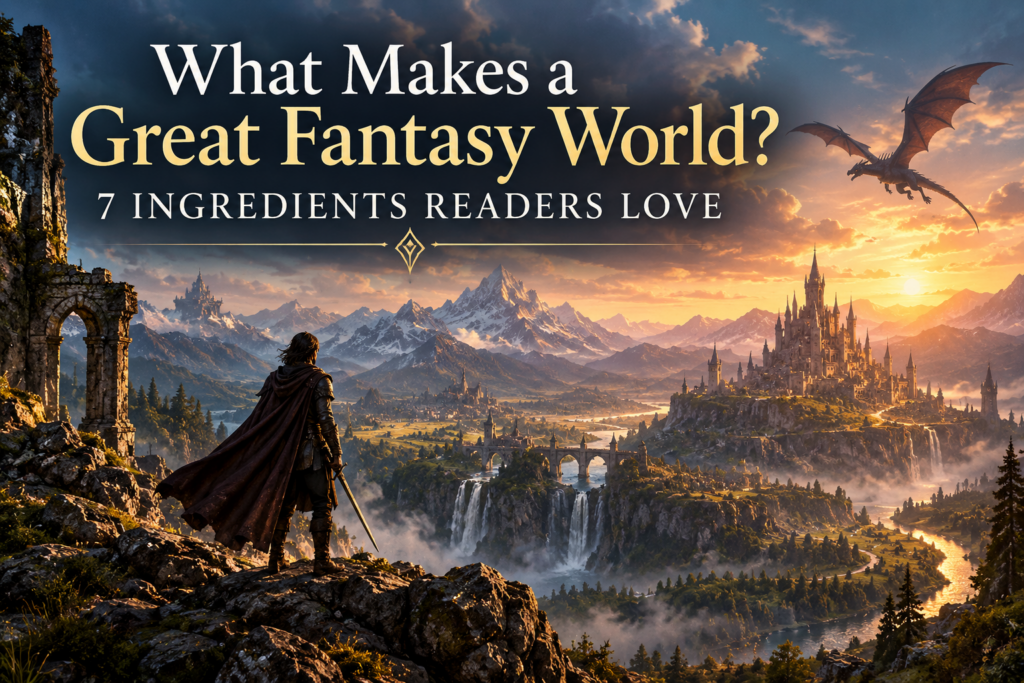
What makes a great fantasy world?
Dragons, magic, enchanted forests and mysterious kingdoms can certainly help. But the fantasy worlds that stay with us long after we finish reading are usually built from something deeper.
The best fantasy worlds feel as though they exist beyond the pages of the story.
They have histories we only partly discover, places we never get to visit, rules that characters cannot simply ignore and mysteries that may never be completely explained.
From Middle-earth and Narnia to Westeros and countless other imagined realms, memorable fantasy worlds invite us to temporarily believe in the impossible.
So, what makes them work?
Here are seven ingredients that can transform an imaginary setting into a fantasy world readers want to explore.
1. A World That Feels Bigger Than the Story
One of the most powerful tricks in fantasy world-building is creating the impression that the reader is seeing only a small part of something much larger.
A distant mountain range may never be visited.
An ancient war might be mentioned only briefly.
A ruined city could appear on a map without ever becoming part of the main story.
These details matter because they suggest that the world existed before the characters arrived and will continue after their adventure has ended.
Great fantasy worlds have depth beyond the immediate plot.
Readers don’t need to know everything.
In fact, sometimes knowing less makes a fantasy world more intriguing.
2. Magic With Rules — and Consequences
Magic is one of the defining pleasures of fantasy, but unlimited magic can quickly create problems.
If a wizard can solve absolutely anything simply by casting the right spell, danger becomes less convincing.
That is why many memorable fantasy worlds place limits on magic.
Perhaps using magic requires enormous energy.
Perhaps only certain people possess it.
Maybe spells have unpredictable consequences.
Or perhaps magic itself comes at a price.
The precise rules matter less than their consistency.
Readers are usually willing to accept almost anything in fantasy — provided the world remains true to its own logic.
And sometimes the things magic cannot do are more interesting than the things it can.
3. A Sense of History
Every real civilisation has a past.
Fantasy worlds should too.
Ancient kingdoms, forgotten wars, vanished peoples, abandoned cities, old alliances and half-remembered legends all create a sense that the present story is only the latest chapter in a much longer history.
Not all of that history needs to be explained.
A mysterious statue beside an ancient road can sometimes tell us more than three pages of exposition.
Perhaps nobody remembers who built it.
Perhaps different cultures have completely different explanations.
Perhaps the truth has been forgotten.
History gives a fantasy world weight.
It also provides something particularly valuable to a storyteller:
Secrets.
4. Places Readers Want to Explore
Setting matters enormously in fantasy.
A great fantasy world should contain places that spark the imagination.
Enchanted forests.
Impossible cities.
Frozen wastelands.
Underground kingdoms.
Floating islands.
Forgotten temples.
Deserts hiding the ruins of ancient civilisations.
The possibilities are almost unlimited.
But memorable locations aren’t simply spectacular scenery. They should influence the story and the people who live there.
A civilisation surrounded by dangerous mountains may develop very differently from one living on fertile plains.
People inhabiting a world with two suns might measure time differently.
A society living alongside magical creatures may regard them as completely ordinary.
The environment helps shape the civilisation.
That makes the world feel real.
5. Cultures That Don’t All Think the Same Way
A fantasy world becomes much richer when its inhabitants see that world differently.
One kingdom might regard magic as sacred.
Another might fear it.
A third could regulate it.
A fourth may believe magic disappeared centuries ago — until something happens that proves otherwise.
Different societies can have their own traditions, values, laws, legends, architecture and attitudes towards outsiders.
They can even interpret the same historical event differently.
This creates one of the most interesting aspects of fantasy world-building:
Nobody necessarily possesses the whole truth.
And once different cultures, beliefs and ambitions collide, stories almost begin writing themselves.
6. Danger, Mystery and the Unknown
A fantasy world shouldn’t feel completely safe.
Somewhere beyond the familiar roads, there should be places where sensible travellers hesitate to go.
Perhaps an ancient forest has a reputation nobody can explain.
Maybe ships disappear beyond a particular island.
Perhaps people avoid the ruins outside a city after sunset.
Or there could be something beyond the mountains that nobody has returned to describe.
The unknown is powerful because imagination naturally fills the gaps.
Fantasy loses some of its magic when absolutely everything is explained.
Readers need answers — but they also need questions.
Sometimes the locked door is more fascinating than whatever eventually lies behind it.
7. Characters Who Belong to the World
Even the most imaginative fantasy setting will struggle to engage readers without compelling characters.
The inhabitants shouldn’t behave like visitors who have just arrived and need everything explained to them.
To them, their world is normal.
A character who has seen dragons flying overhead since childhood probably isn’t going to stop and marvel every time one appears.
A healer who uses magic every day may regard it as a profession rather than a miracle.
A farmer living near a dangerous enchanted forest may simply know never to cross a particular stream after dark.
Small details like these make fantasy worlds believable because they show how extraordinary circumstances become part of ordinary life.
And ultimately, readers experience a fantasy world through its characters.
We care about the kingdom because they care about it.
We fear the monster because they fear it.
And we want to discover what lies beyond the mountains because they do too.
The Secret Ingredient: Make the Impossible Feel Real
Perhaps this is the real secret behind great fantasy world-building.
Fantasy doesn’t need to be realistic.
It needs to be believable within its own reality.
A world can contain magic, monsters, portals, impossible landscapes and forces that defy our understanding of physics.
But once the rules of that world have been established, they need to matter.
Actions should have consequences.
Characters should have limitations.
History should influence the present.
And the world should feel as though it would continue existing even if the main characters disappeared tomorrow.
That is when an imaginary setting becomes something more.
It becomes a place.
When Science and Fantasy Collide
Fantasy worlds don’t necessarily have to abandon science.
Sometimes the most intriguing fictional universes exist somewhere between the two.
What one civilisation calls magic might be understood very differently by another.
Something that appears supernatural could have rules that nobody yet understands.
And sufficiently strange science can sometimes feel remarkably like magic.
That boundary between the known and the impossible is something I particularly enjoy exploring in my Darker Matter fiction.
The stories combine elements of science fiction and fantasy, creating worlds where the mysteries of the Universe can lead somewhere unexpected.
Because perhaps the most exciting question in speculative fiction isn’t whether something is science or magic.
It’s simply:
What if it were possible?
Why We Love Fantasy Worlds
Perhaps we love fantasy worlds because they allow us to rediscover something that becomes harder to find in everyday life:
Wonder.
They remind us what it feels like to look beyond the horizon and genuinely have no idea what might be there.
They give us impossible places to explore, extraordinary characters to meet and mysteries to solve.
For a few hours, the normal rules disappear.
A wardrobe can lead to another world.
A forgotten doorway can hide an ancient secret.
The stars might contain something nobody has imagined.
And the road disappearing into the forest might lead absolutely anywhere.
That is the magic of a great fantasy world.
It doesn’t simply tell us a story.
It makes us wish we could visit.
Discover the Worlds of Darker Matter
If you enjoy fantasy and science fiction that explores strange worlds, mysterious forces and the boundary between science and magic, discover the Darker Matter books.
Sometimes the greatest adventures begin when the world we thought we understood turns out to be something very different.
Comments are closed.