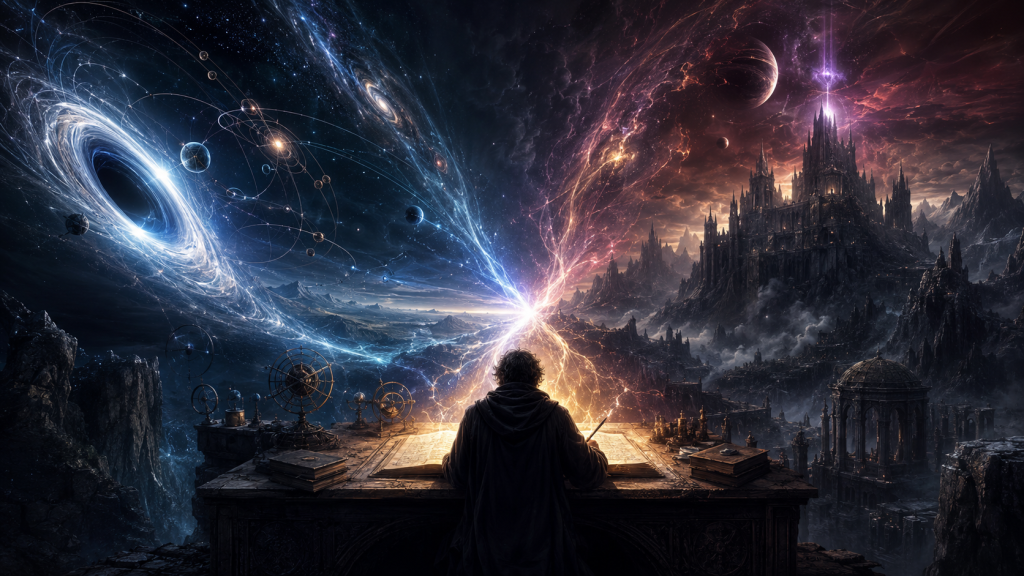
Writing epic fantasy offers enormous freedom. An author can create new worlds, invent ancient civilisations and unleash forces that do not exist in our own reality. However, that freedom becomes more complicated when the story also draws inspiration from real-world science.
While writing the Darker Matter series, I wanted magic, science fiction and scientific ideas to exist within the same universe. That created exciting possibilities, but it also presented a recurring challenge: how could I respect real science without allowing it to restrict the imagination at the heart of an epic fantasy story?
Where Science Ends and Imagination Begins
One of the greatest challenges of writing epic fantasy with real-world science is deciding where scientific plausibility should end and imagination should take over.
Concepts such as dark matter, wormholes, multiple dimensions and the manipulation of energy offer fascinating foundations for fiction. However, many of these subjects remain theoretical or are not yet fully understood. That uncertainty is both helpful and difficult for a writer.
It creates room for imagination because science does not yet have all the answers. Nevertheless, it also means that I must distinguish between established knowledge, scientific theory and pure invention.
My aim has never been to write a physics textbook disguised as a fantasy novel. Instead, I use real scientific ideas as the starting point for something larger, stranger and more dangerous.
Making the Impossible Feel Believable
Readers do not necessarily need to know exactly how a magical force works. However, they do need to feel that it follows rules. If a character can escape every danger by suddenly discovering a new power, the story begins to lose tension.
Therefore, the magic in Darker Matter has limits and consequences. Power has a source. It can be resisted, redirected or misused. Above all, it carries a price.
This is where real-world science becomes especially useful. Science encourages a writer to think in terms of cause and effect:
- Where does the energy come from?
- What happens when it is released?
- Can it be controlled?
- What are the consequences if that control fails?
- Does every action produce an equal or unexpected reaction?
These questions help make an impossible event feel believable within the fictional universe.
Avoiding Too Much Scientific Explanation
Research is an important part of writing science fantasy. However, including everything discovered during that research can easily slow the story.
This creates another difficult balancing act. I want the scientific ideas to have substance, but I do not want readers to feel that the adventure has stopped for a lecture.
For me, the science must serve the story. It should deepen the mystery, increase the danger or help readers understand what is at stake. If an explanation does none of those things, it probably does not need to be there.
Often, a carefully chosen detail is more effective than several pages of technical information. The reader can sense that there is a believable idea beneath the surface without needing to understand every equation behind it.
Creating Rules That Work Across Different Worlds
The Darker Matter saga brings together our scientifically understood world and the magical realm of Zandyros. Each has its own history, beliefs and understanding of reality.
That raises an important question: are science and magic separate forces, or are they different interpretations of the same thing?
A scientist might describe an event in terms of energy, dimensions or spacetime. A sorcerer might interpret the same event as an ancient power governed by will, ritual or destiny. Both could be observing the same underlying phenomenon without sharing the language to explain it.
This contrast became one of the most interesting parts of writing the series. It also allowed the characters to reflect the reader’s own uncertainty. When people from different worlds meet, neither side immediately has all the answers.
Their conflicting explanations create tension, but they also reveal that knowledge depends partly on perspective.
Preserving Wonder and Mystery
Science is sometimes portrayed as the enemy of mystery. Once something has been explained, the wonder supposedly disappears.
I have never believed that.
The real universe is filled with extraordinary mysteries. Most of its matter cannot be seen directly. Space and time can be distorted by gravity. Scientists continue to explore questions about black holes, other dimensions and the fundamental nature of reality.
For a fantasy writer, these ideas do not reduce the sense of wonder. They expand it.
The challenge is to avoid explaining so much that every mystery disappears. Some questions should remain unanswered, particularly when the unknown is part of what makes a world feel ancient, vast or threatening.
Readers need enough information to follow the story. However, they should also feel that something much greater exists beyond the limits of the page.
Keeping the Characters at the Heart of the Story
The biggest danger when writing about complex scientific ideas is forgetting that readers connect most strongly with people.
A portal between worlds may be based loosely on theories surrounding wormholes and spacetime. Yet the science alone does not make the moment exciting. What matters is who opens the portal, why it happens and what comes through it.
Similarly, a force capable of consuming light and energy becomes meaningful when it threatens something, or someone, the reader cares about.
For that reason, I try to experience the science through the characters. Some react with curiosity, others with disbelief or fear. Their emotional responses turn an abstract concept into part of a human story.
No matter how large the world becomes, the reader still needs someone to follow through it.
Knowing When to Break the Rules
Researching real science can sometimes make a writer too cautious. There is always the temptation to ask whether every event could genuinely happen.
However, epic fantasy needs room to be epic.
There comes a point where the story must move beyond current scientific knowledge. Portals can open. Magic can reshape reality. Ancient beings can wield powers that humanity does not understand.
The important thing is not whether these events are possible in our world. It is whether they feel possible in the world of the story.
Once the rules have been established, breaking one of them can also become a powerful dramatic moment. However, the exception must have meaning and consequences. Otherwise, it risks feeling like a convenient solution.
Why Real Science Is Worth the Challenge
Writing epic fantasy with real-world science is not always straightforward. Too little explanation can make an idea feel arbitrary, while too much can overwhelm the story. Scientific accuracy must be balanced against pace, character and imagination.
Nevertheless, I believe the effort is worthwhile.
Real science provides a foundation from which extraordinary ideas can grow. It encourages deeper world-building and creates questions that neither science nor magic can answer alone.
That tension lies at the heart of the Darker Matter series. It is a universe in which the laws of physics encounter forces older and more powerful than humanity understands. The result is not simply science fiction with magic added to it. Instead, it is a world where science and sorcery challenge each other and where the boundary between them is never entirely clear.
If you enjoy epic fantasy filled with dangerous magic, otherworldly realms and mysteries inspired by real science, discover the Darker Matter saga, beginning with Dakor’s Darkness
Comments are closed.