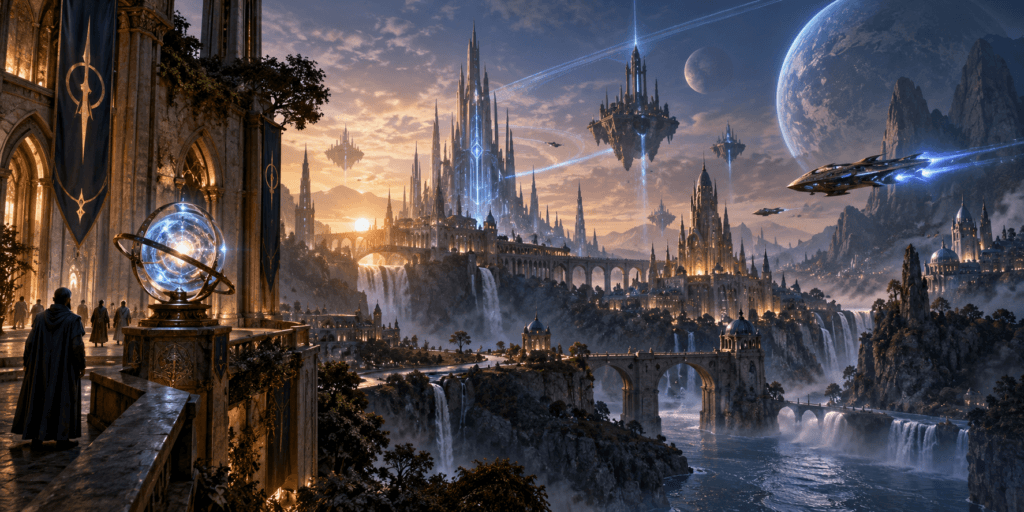
Imagine waking tomorrow morning on a world where magic is not a myth, a superstition or something confined to fantasy novels.
It is real.
More importantly, it works.
On a planet dominated by magic, the supernatural would not simply provide an occasional spectacle. It would influence almost everything: government, warfare, medicine, transport, education, wealth and perhaps even the way people understand reality itself.
But would such a world be wonderful?
Or terrifying?
The answer might depend entirely on one question:
Who controls the magic?
Magic Would Become a Form of Power
Throughout human history, societies have been shaped by access to valuable resources.
Land created wealth. Metals created weapons. Coal powered industry. Oil transformed transport. Information became one of the defining resources of the modern age.
On a world where magic genuinely existed, magical ability could become the most valuable resource of all.
Those capable of controlling it might quickly acquire enormous influence.
A gifted healer could become more valuable than a hospital. Someone able to predict events might influence governments or markets. A person capable of manipulating matter, weather or minds could possess power beyond anything available to an ordinary citizen.
Magic would therefore be unlikely to remain simply a personal talent.
Sooner or later, society would attempt to organise it, regulate it and control it.
Would Governments Control Magic?
If magic were powerful enough to affect other people, governments would almost certainly take an interest.
Would magical practitioners need licences?
Would certain spells be illegal?
Would magical abilities have to be registered?
Perhaps some forms of magic would be treated much like dangerous weapons, while others might become recognised professions.
Entire government departments could exist to investigate magical crimes or prevent the misuse of supernatural abilities.
And governments themselves might employ powerful practitioners.
That raises a more uncomfortable possibility.
If magic provided political power, would democratic institutions survive unchanged?
A ruler capable of supernatural influence might be extremely difficult to challenge.
Magic Could Transform Everyday Life
Not every consequence would be sinister.
A planet dominated by magic could be an extraordinary place to live.
Imagine buildings created or repaired through magical means. Journeys that take seconds rather than hours. Crops protected from disease or drought. Injuries healed rapidly. Communication across vast distances without conventional technology.
Many things we regard as technological problems might instead have magical solutions.
That could also mean that technology developed very differently.
Why invent an aircraft if people can travel magically?
Why develop antibiotics if magical healing works better?
Why build power stations if another force can provide energy?
A civilisation based upon magic might therefore become highly advanced without resembling our own technological society at all.
What Would Happen to Science?
The existence of magic would not necessarily destroy science.
In fact, it could create entirely new branches of it.
Scientists might attempt to understand why magic works, what its limitations are and whether its effects can be measured.
Universities could have departments devoted to magical theory. Researchers might conduct controlled experiments on spells or supernatural phenomena. Scientists and magical practitioners could collaborate, or become fierce rivals.
Eventually, the distinction between science and magic might become surprisingly difficult to define.
If a supernatural force follows predictable rules and can be repeatedly demonstrated, is it still magic?
Or has it simply become another part of physics?
A Planet Dominated by Magic Would Need Rules
Magic becomes particularly interesting when it has limitations.
If anyone can achieve anything simply by wishing for it, many of the challenges that make life meaningful disappear.
But suppose magic has a cost.
Perhaps it requires enormous concentration. Maybe it consumes physical energy. Perhaps certain abilities take decades to master. Some forms of magic might require rare substances or work only under particular conditions.
There could even be consequences for using too much of it.
Those limitations would shape civilisation.
Rare magical resources could become extraordinarily valuable. Nations might compete for them. Trade routes could develop around them. Wars might even be fought over access to places where magical energy is particularly strong.
Magic would create opportunitie, but it could also create scarcity.
And scarcity creates conflict.
Would Magic Make Society More Unequal?
One of the biggest questions would be whether magical ability was distributed equally.
Suppose only a small proportion of the population possessed significant magical power.
They would have an enormous advantage.
A magical elite could emerge, controlling wealth, government, education and perhaps even the military.
Families might attempt to preserve magical abilities through generations. Powerful magical bloodlines could become the equivalent of aristocratic dynasties.
Alternatively, society might try to prevent this.
Schools could identify magically gifted children regardless of background. Governments might restrict inherited power. Laws could attempt to ensure that magic was used for the benefit of everyone.
The struggle between those two possibilities could define the politics of an entire civilisation.
Education Would Be Completely Different
If magical ability existed, education might begin very differently from anything we recognise today.
Children could be tested at an early age to discover whether they possessed magical abilities. Schools might teach students how to understand and control those powers alongside more familiar subjects.
But this would raise difficult questions.
What happens to a child with exceptional magical ability?
Would they attend specialist schools? Would governments take a particular interest in them? Could parents refuse to allow their children to receive magical training?
And what about children with little or no magical ability?
In a society where magic provides enormous advantages, education could become the dividing line between opportunity and exclusion.
The way a civilisation teaches its children to use magic might ultimately determine whether that power becomes a force for progress, or something far more dangerous.
Warfare Could Become Almost Unrecognisable
Unfortunately, almost every powerful human discovery has eventually found a military application.
Magic would probably be no exception.
Traditional armies might become vulnerable to a handful of highly trained magical practitioners. Defensive magic could become as important as physical fortifications.
Espionage would also change dramatically.
How do you protect secrets in a world where someone might be able to read thoughts, see distant locations or influence another person’s behaviour?
The greatest military powers might not possess the largest armies.
They might simply possess the strongest magic.
That could create an uneasy balance between nations, especially if the most destructive magical abilities were capable of devastating entire cities.
Crime and Justice Would Change Too
Imagine investigating a crime in a world containing magic.
Could someone magically disguise themselves?
Alter another person’s memories?
Create an illusion?
Disappear from a locked room?
Traditional evidence might suddenly become far less reliable.
But magic could help investigators too.
Perhaps objects retain traces of their previous owners. Maybe magical techniques can reveal events from the past. Specialist investigators might combine conventional detective work with supernatural abilities.
Courts would face equally difficult questions.
Could magically obtained evidence be trusted?
Could witnesses be influenced?
Could someone genuinely claim that they committed a crime while under magical control?
A magical civilisation would need an entirely new body of law.
The Most Dangerous Magic Might Be the Most Subtle
When we imagine magical power, it is easy to picture spectacular events, lightning, fire, levitation or enormous displays of supernatural energy.
But the most powerful abilities might be almost invisible.
Imagine being able to influence someone’s emotions.
Alter their memories.
Change what they believe they have seen.
Or subtly affect the decisions of thousands of people without them ever knowing.
In such a society, the greatest threat might not come from the person capable of destroying a building.
It might come from someone capable of changing minds.
Would We Actually Want to Live There?
At first glance, a magical planet sounds wonderful.
Disease might be easier to treat. Travel could become effortless. Extraordinary abilities could transform everyday life.
Yet every advantage would create new questions.
Who gets access to magic?
Who controls it?
Who decides how it may be used?
And what happens when someone becomes powerful enough to ignore the rules?
Perhaps magic would not fundamentally change human nature at all.
It would simply give human ambition, generosity, curiosity, greed, courage and fear entirely new ways to express themselves.
And that may be what makes the idea so fascinating.
Exploring Worlds Where the Impossible Becomes Real
These are exactly the kinds of questions that make speculative fiction so compelling.
The most interesting fantasy worlds are not simply places where magic exists. They explore what happens because magic exists.
How does society adapt?
How does power change?
What happens when ordinary people encounter forces they do not fully understand?
And what happens when the rules governing those forces begin to break?
These themes lie at the heart of the Darker Matter books, stories that explore extraordinary worlds, supernatural forces and the consequences that follow when reality is not quite as dependable as we imagine.
If you enjoy fiction that asks “What if?” and then follows that question into darker and more unexpected territory, you can discover more about the Darker Matter series and my books here.
Sometimes the most unsettling worlds are not those completely different from our own.
They are the ones that feel almost familiar.
Until something impossible happens.
Comments are closed.